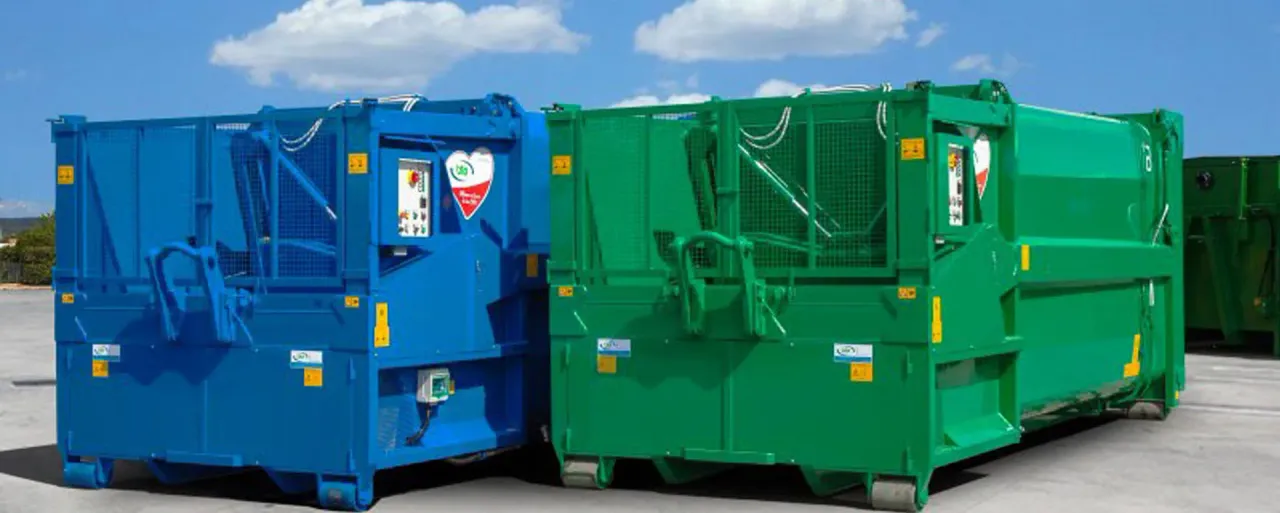
Press containers and skips
We supply press containers, stationary presses, hook-lift systems and skips for collection and material handling.
Discover more
Guides and resources
Press containers, hook-lift compactors or conventional skips: how to choose by material, volumes, compaction and logistics. Bunder analysis for depots and services.
Press containers, hook-lift compactors and skips perform different functions, even though commercial language sometimes treats the terms as synonyms.
The most useful distinction answers a concrete question: must material only be collected and transported, or is it worth reducing volume where it is produced or deposited?
A traditional hook-lift skip mainly contains and transports material. A hook-lift compactor integrates a compaction system that reduces volume before transport. “Press container” often indicates equipment with an built-in press. In Italian technical documentation and specifications definitions can overlap, so before comparing offers always verify the actual equipment configuration.
Bunder offers both families through its BTE range: hook-lift plants and compactors, hook-lift containers, multi-hook systems, loaders and stationary presses. The range covers very different wastes and materials, from municipal solid waste to packaging, wood, green waste, scrap, agricultural and construction materials.
Correct choice requires analysing material, inbound flow, distance to plant, transport frequency, available space and how equipment will be moved, not only skip capacity and price.
The hook-lift skip is essentially a movable container handled by a truck with hook-lift equipment.
It does not necessarily perform compaction. Its job is to collect material, contain it and allow transport.
That simplicity is often an advantage.
A skip can be configured for very different materials with covers, doors, compartments and other build features. BTE indicates hook-lift skips for MSW, construction materials, paper and cardboard, timber, green waste, ferrous scrap, agricultural materials, organics, glass, ceramics and other uses. Configurations can be customised for dimensions, colour, cover systems and doors.
The skip is particularly interesting when material does not need compaction or when the priority is a simple, robust, flexible container.
The hook-lift compactor adds a mechanical or electro-hydraulic system for volumetric reduction.
BTE offers single-blade, sliding-box, auger and special hook-lift compactors. Deposit can be manual or directly from collection vehicle discharge. Systems are used, among others, at eco-islands, bring sites, supermarkets, paper mills and production sites.
The principle is simple: instead of transporting all material as deposited, part of the volume is reduced inside the equipment.
That can significantly change the relationship between collected quantity and number of trips needed.
“Press container” is widely used in commercial and technical practice for a container with a pressing system.
Italian documentation also uses expressions such as “sliding-box press container”, “single-blade press container” or “hook-lift compactor”. Terminology is not fully uniform. When preparing a tender or comparing quotes, specify compaction type, container configuration, feeding mode and handling mode rather than relying on the name “press container” alone.
In this article we use “press container” as the commercial term for a hook-lift system with compaction, distinct from a skip without a press.
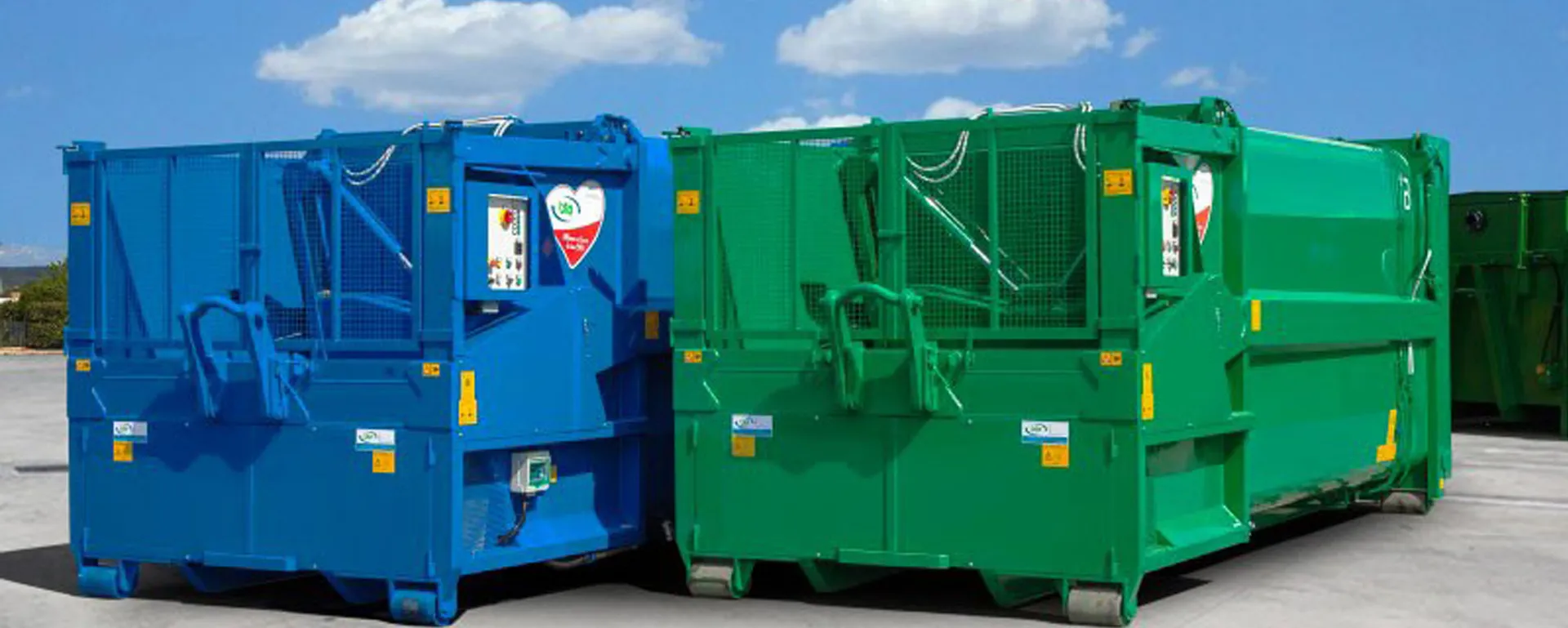
Compaction value appears especially when material occupies much volume relative to weight.
Typical flows include:
BTE expressly indicates hook-lift compactors for paper, cardboard, plastic, MSW, organic waste and industrial processing waste, with different configurations by material and compaction process.
For already dense, little-compressible material, high compaction capacity may bring limited benefit.
The right question is therefore not:
“How many cubic metres does the box hold?”
but:
“How many cubic metres must I transport before and after compaction, and what is the real weight limit?”
This distinction is fundamental when calculating transport cost.
A skip without compaction can be the most rational choice when material:
Examples include excavation materials, rubble, scrap, timber or materials loaded with crane, grab or loader.
BTE offers hook-lift skips for several of these flows, including versions for ferrous scrap, rubble and inert materials, wood and ash, sludge and other materials.
Introducing compaction might add complexity without proportional benefit.
The traditional skip also has a clear organisational advantage: when full, it is swapped or transported without managing a compaction cycle.
The main advantage of compaction is logistical.
Suppose, conceptually, a very bulky cardboard flow that quickly fills a skip but has relatively low mass.
Without compaction the limit may be mainly volumetric.
With a compactor, part of the volume is reduced before transport and the box can hold more material in the same space.
That does not mean compaction indefinitely multiplies transportable quantity. At some point the constraint becomes weight, equipment payload or truck limits.
Correct assessment must consider:
material volume → compaction degree → transported mass → number of trips.
That chain, more than skip volume alone, determines operational benefit.
The greater the distance between collection point and treatment or disposal plant, the more important it is to use each trip well.
A supermarket, shopping centre or production site generating large quantities of low-density cardboard is a concrete example.
If the box quickly reaches volumetric limit and the plant is many kilometres away, logistic cost of frequent trips can become significant.
In that scenario compaction can be worth more than at the same site with a very close destination plant.
Solutions exist specifically to separate collection and transport in time. The Busi Group CWS B5, for example, combines side collection with a hook-lift body: when the compactor is full, the box can be swapped for an empty one and the full one transported separately by a hook-lift truck. The manufacturer indicates this configuration also when drop-off is far from collection and for seasonal flows.
Here value is not only compaction.
It is the ability to separate collection phase from transport phase.
This point is often underestimated.
Equipment can be very efficient at collecting material but inefficient at transporting it, or the opposite.
A site may produce material continuously all day while transport to the treatment centre happens at much longer intervals.
A hook-lift configuration allows equipment to stay at the production point and organise transport when the box is full or logistics require it.
BTE offers hook-lift systems for collection, transport and compaction; skips can be configured to stay on site awaiting movement.
This model differs from a fixed container emptied frequently by a dedicated truck.
A compactor is not fed the same way in every plant.
Deposit can be:
BTE indicates this possibility for hook-lift compactors, which can receive material manually or directly from collection vehicles.
Two compactors with the same nominal capacity can therefore deliver very different operational results.
Slow feeding or heavy manual work makes compaction chamber capacity only part of the problem.
In a plant with continuous automated flow, the feeding system can become the real bottleneck.
Paper and cardboard typically occupy large volume.
BTE offers single-blade and sliding-box hook-lift compactors for paper, cardboard and packaging. Sliding-box compactors are indicated specifically for cardboard boxes, cardboard, cellophane and light plastics.
Choice depends on the flow.
A small shop with discontinuous quantities may find a skip or mini compactor simpler.
A shopping centre with continuous production may prefer on-site volume reduction.
A paper mill or printing company with constant production may need a more structured setup, possibly with stationary press and dedicated container.
Bunder also includes BTE stationary presses, so the project can be assessed above a simple skip versus press container comparison.
There is an important difference between a hook-lift compactor and a stationary press.
In the first case compaction is part of the equipment that is moved.
In the second the compacting section stays installed on site and material is transferred into the container that, once full, is taken away.
Busi Group describes stationary presses as industrial plants where the compacting section is fixed and material is discharged into hook-lift containers. They are indicated for bulky materials such as packaging, cardboard, plastic, wood and production waste, also with feeding from conveyors or automatic emptying systems.
This can be interesting when:
It is not necessarily the best solution for a point that must remain easily reconfigurable.
A container with built-in compaction must be moved with the equipment.
With a stationary press, only the full container is moved.
BTE has hook-lift containers designed to work with stationary presses. Some models are configurable for the press and material treated. The CNTTR triconic container, for example, is designed for stationary presses and uses geometry that favours material distribution during compaction and gravity discharge.
In a high-flow plant this architecture can have significant logistic advantage.
The press keeps working while the full container is replaced, provided the system was designed with adequate container number and configuration.
Choosing “a hook-lift compactor” does not finish the design.
Compaction technology must match material and loading mode.
In BTE single-blade models, compaction uses a blade that gathers, drags and pushes material to the bottom of the box. The range includes standard, mini and front-discharge versions.
The mini version is proposed where space is limited and movement is by small or medium hook-lift trucks.
The sliding-box compactor uses a blade moving horizontally to push material to the bottom.
BTE indicates it for MSW and similar materials, paper, cardboard, cellophane, light plastics and industrial processing waste. The hydraulic unit is accessible from outside to ease maintenance.
Auger compactors are a further BTE category. Choosing this technology requires specific assessment of flow and material type.
There is no “universal compactor” selectable on body volume alone.
When material has a significant liquid fraction, criteria change.
Important aspects become:
BTE single-blade compactors are described, for example, as watertight thanks to compression chamber floor configuration; versions and equipment must still be assessed for the material treated.
It is wrong to conclude any compactor suits any wet fraction.
Choice must refer to the specific model, material and process requirements.
In industry choice can be even more articulated.
The same plant might simultaneously produce:
Not all flows must use the same equipment.
Busi Group indicates BTE and MEC solutions for numerous waste and raw material flows, including packaging, organics, wood, green waste, metals, excavation materials, construction waste, agricultural products and other materials.
A company may find it more convenient to create a small system of specialised containers rather than one compactor for everything.
Separate collection of material can also affect subsequent recovery.
At bring sites skip flexibility often remains important.
The same point may handle very different materials with different loading modes.
BTE indicates hook-lift compactors for bring sites and eco-islands, with manual deposit or via collection vehicles. Hook-lift skips are available in specific configurations for MSW, selective collection, wood, scrap, construction materials and other flows.
The question to ask:
which flows must be compacted and which only collected and moved?
The answer can lead to a mixed configuration.
Not all industrial sites have a large yard.
Limited space can change equipment choice.
BTE offers a mini version of sliding-box compactors for reduced space, including enclosed environments. The configuration keeps compaction principle but reduces footprint and can be moved by smaller hook-lift trucks than larger models.
Space must be assessed on the whole cycle:
Box volume is only one dimension to consider.
This is another decisive criterion.
With a traditional skip, the operational model is relatively simple: the full box is taken and replaced with an empty one.
With a hook-lift compactor, equipment including the compaction system is moved.
With a stationary press, the compacting section stays on site and only the container is moved.
The last configuration can be particularly interesting for continuous, substantial flows.
The hook-lift compactor can be simpler to install and more flexible when you do not want a fixed plant.
The traditional skip remains simplest when material does not need compaction.
These are three different operational logics.
Distance to recovery, treatment or disposal centre must be considered with material.
Depositing 10 tonnes of dense material and transporting 10 tonnes of bulky cardboard is not the same logistic problem.
In the second case available mass on the truck may be far below payload while box space is already full.
Compaction can therefore have greater value when volume is the main constraint.
Conversely, if the truck reaches weight limit before filling volume, increasing compaction may not produce proportional savings.
Correct dimensioning should start from real flow data.
Imagine a supermarket with consistent daily cardboard and packaging production.
With a traditional skip, the problem may be quickly reaching maximum volume.
A press container can reduce volume and allow more material to accumulate before swap.
If the drop-off centre is distant, logistic benefit can increase because each trip moves more compacted material.
If the supermarket has very limited space, verify whether the hook-lift cycle fits manoeuvre areas.
If production is very high and continuous, a stationary press with dedicated containers may be more appropriate.
There is no single answer even for an apparently simple scenario.
A construction company may produce very different materials: timber, packaging, rubble, metals and others.
One compactor would probably be too generic.
It may be more logical to use dedicated skips for flows that must not be compacted and specific equipment for cardboard and other bulky materials when quantities justify it.
BTE offers specific skips for rubble and inert materials, ferrous scrap, wood and other materials.
Flow separation must align with the company’s waste management system.
A bring site may simultaneously need:
System flexibility matters as much as capacity.
BTE offers hook-lift skips for selective collection and various material categories, plus hook-lift compactors usable at bring sites.
Sound design should start from the site flow map, not the number of skips to buy.
| Situation | Hook-lift skip | Compactor / press container | Stationary press + container |
|---|---|---|---|
| Dense, little-compressible material | Very suitable | To assess | Generally not needed |
| Bulky cardboard and packaging | Possible | Often interesting | Interesting with high flows |
| Discontinuous production | Very flexible | Interesting if volume is high | Less suitable |
| Continuous production | Suitable | Suitable | Particularly interesting |
| Need to reduce volume | Limited | High | High |
| Very limited space | Depends on configuration | Mini versions available | Requires permanent installation |
| Long distance to plant | Can increase trips | Can improve transport efficiency | Very interesting with continuous flows |
| Many different materials | Very flexible | Configure per flow | Assess for specific lines |
| Bring site | Very suitable | Useful for bulky flows | Useful in specific setups |
| Industrial plant with automated line | Possible | Possible | Particularly suited |
The table is an initial guide. Final configuration must be verified for material, payloads, space and transport modes.
Before requesting an offer, an operator or company should gather at least:
Material
Which waste or raw material must be handled?
Production
How many kilograms or tonnes per day, week or month?
Volume
How much space does material occupy before compaction?
Frequency
How often is the container today swapped or emptied?
Distance
How many kilometres from production point to destination plant?
Space
How much space for installation, deposit, movement and manoeuvre?
Loading mode
Manual, tipper, collection vehicle, conveyor or other system.
Available payload
Which trucks will hook-lift and transport?
Material handling
Need for liquid containment, cover, tightness or specific configuration?
Objective
Reduce trips, increase autonomy, separate flows, improve area order, automate process or simply gain capacity.
With this data you can see whether you really need a skip, a compactor or a more structured compaction plant.
Greater volume does not necessarily solve the problem.
If material is bulky but light, the real limit may be space, not payload.
Initial cost is only part of the project.
Also consider transport, number of collections, movement times, energy, maintenance and staff organisation.
Not all materials benefit equally from compaction.
Technology must be chosen for the flow.
Skip or compactor must be movable by available truck.
Technically suitable equipment incompatible with the truck or hook-lift space creates an operational problem.
The limit can be volumetric or by weight.
An effective system must be dimensioned for both.
A site producing material eight hours a day has different needs from occasional volume.
With continuous flow, stationary press or box-swap systems can become particularly interesting.
Skips, press containers and hook-lift compactors are not three ways to sell the same product.
They represent three different levels of material management.
The hook-lift skip is the simplest solution when the main need is to contain and transport.
The hook-lift compactor adds volumetric reduction and can pay off when material is bulky, quantities are significant or distance to plant makes reducing transport important. BTE has single-blade, sliding-box, auger and special configurations.
Stationary press with container is a further integration level, particularly interesting when flow is continuous and the production point can host a fixed plant.
To choose, start from five questions:
What material must I handle?
How much do I produce?
How much volume before and after compaction?
How far is the destination plant?
How should collection and transport actually work?
Only after these answers does comparing models, capacities, compaction systems and costs make sense.
Bunder offers hook-lift systems, compactors, containers, stationary presses and complementary equipment for urban hygiene and material management, with an approach also oriented to assessing needs and volumes to identify the most suitable solution.
The hook-lift skip is mainly a container for collection and transport. The hook-lift compactor integrates a compaction system that reduces material volume before transport.
Terms are often used as synonyms in commercial practice, but terminology is not fully uniform. In supply, specify compaction type and equipment configuration rather than relying on “press container” alone.
It is particularly interesting when material is bulky, volume is the main transport limit and volumetric reduction can reduce necessary movements. BTE proposes these systems also for paper, cardboard, plastic, MSW and industrial waste.
It depends on configuration. BTE containers are proposed for MSW, scrap, construction materials, wood, green waste, paper, cardboard, glass, agricultural materials, sludge and other flows.
No. Need depends on quantities, volume produced, collection frequency and distance to destination plant. Compaction becomes particularly interesting when material quickly reaches volumetric limit.
It can be interesting when flow is continuous, quantities are high and the plant can be installed stably at the production point. The press stays on site while the container is swapped and transported.
Yes. BTE indicates hook-lift compactors for bring sites and eco-islands. Deposit can be manual or via collection vehicles.
It depends on equipment and configuration. Compaction technology must be verified against materials treated. When flows differ greatly, separate equipment may be more rational.
It affects number and duration of transports. The more voluminous material is relative to weight, the greater the value of volumetric reduction, provided compaction system suits the flow.
Yes. BTE offers, for example, a mini sliding-box compactor for reduced spaces and enclosed environments.
Yes, but configuration must suit the material. BTE offers versions for different flows, with customisation on dimensions, covers and doors.
Analyse material, quantities, density, volume, collection frequency, distance to plant, available space, loading mode, transport vehicle and operational objective. Only then compare technologies and models.
Choice between skip, press container and hook-lift compactor should not start from the catalogue.
It should start from material flow.
Bulky waste produced continuously and sent to a distant plant may need a completely different solution from dense material collected occasionally at the same site.
Bunder has a range including containers, hook-lift compactors, hook-lift plants, stationary presses and complementary systems. Assessment can be built around real service organisation, quantities and site conditions.
Bunder product pages and solutions linked to what this article covers.
We supply press containers, stationary presses, hook-lift systems and skips for collection and material handling.
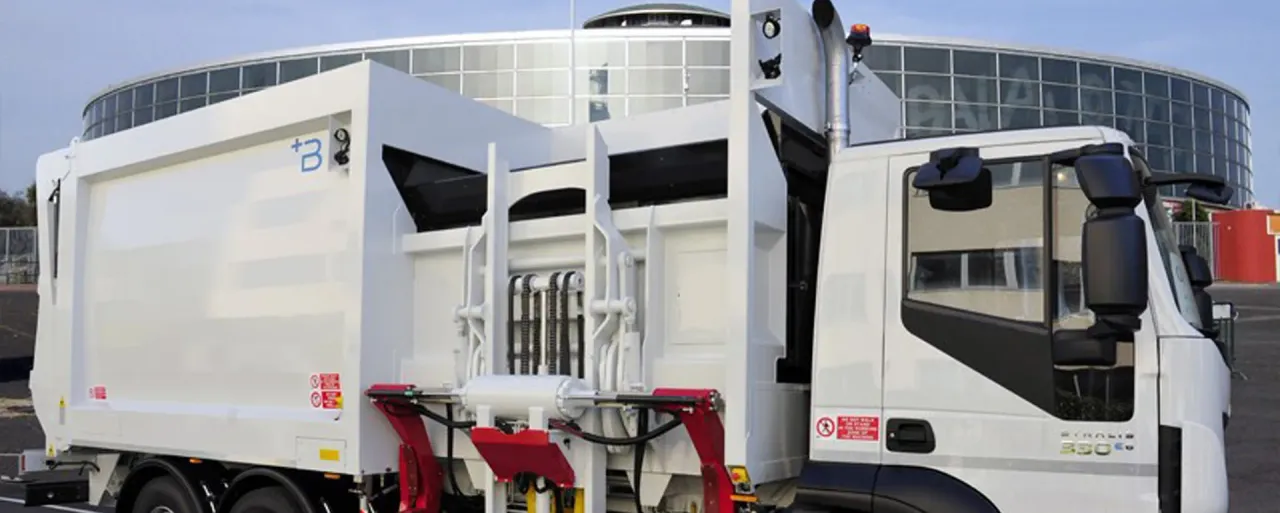
We configure side- or rear-loading refuse compactors on truck chassis, including multi-axle, for every waste type.
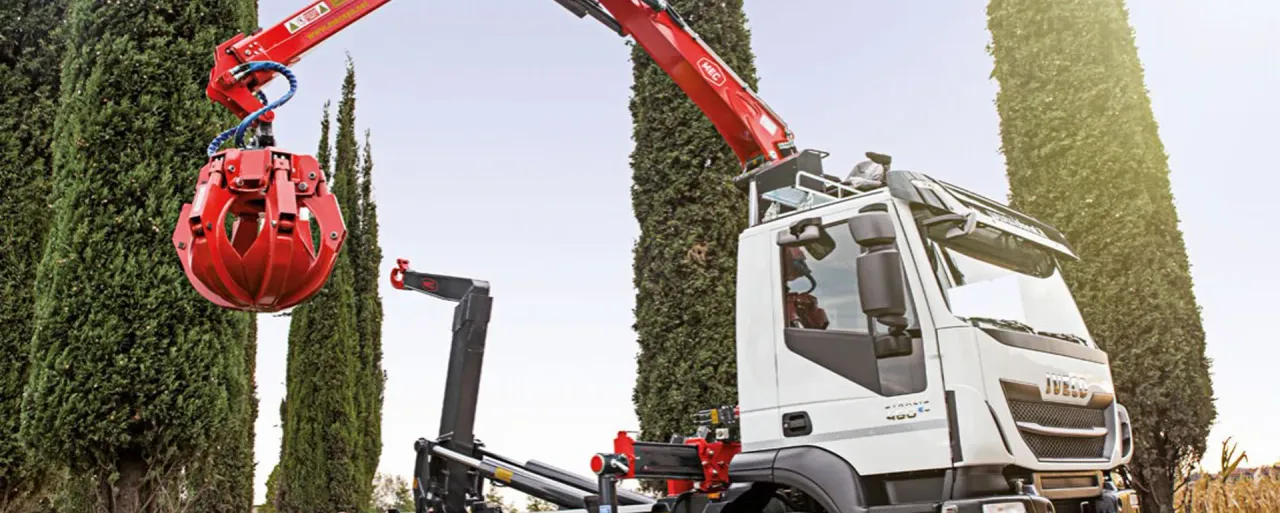
We handle loading and unloading at depots with loaders, grab cranes, multi-skip units and truck-mounted cranes.
Guides and articles linked to this solution: operational context, design choices and useful references.
Comparing side-loading and rear-loading refuse compactors: bins, crew, road layout, fleet and service organisation. Bunder guide to choosing a system.
Buying or renting waste collection equipment: comparing TCO, maintenance, service life, downtime and operational requirements. Bunder guide to the decision.
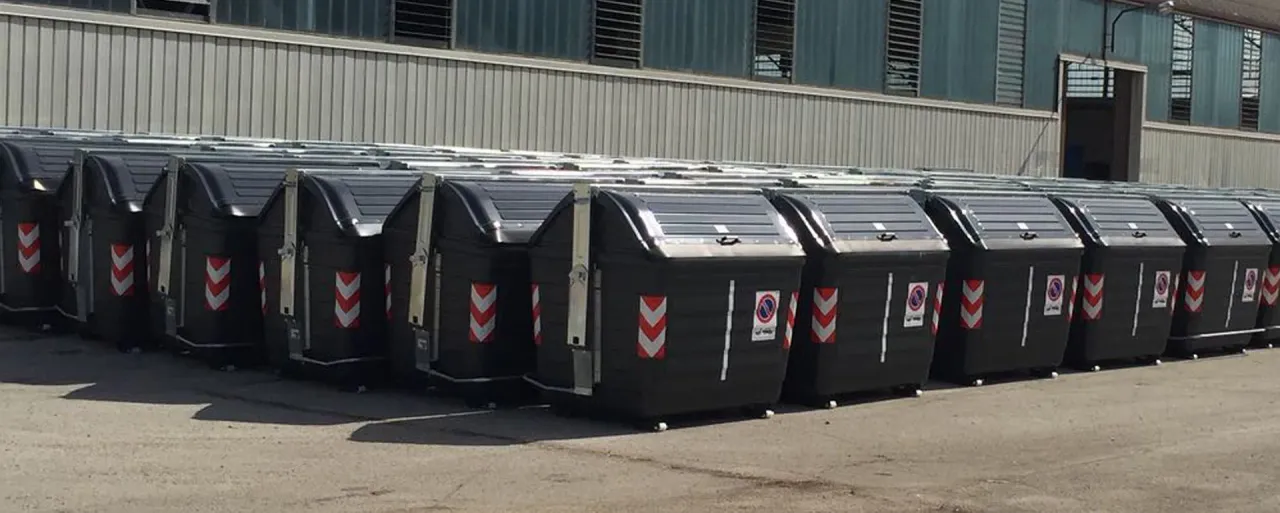
How to draft specs for waste collection containers and equipment: requirements, CAM, technical details and equivalence. Bunder guide for authorities.